

For most of 2021 through 2024, U.S. biotech was where capital went to be forgotten. The SPDR S&P Biotech ETF (XBI) spent years chopping inside a wide, frustrating range while the S&P 500 compounded higher on the back of mega cap technology.
That relationship has now inverted. Biotech has quietly become one of the best performing sectors in the market, and the move is being validated by both the fundamental backdrop and the price chart at the same time, a combination Macro Lens rarely sees line up this cleanly.
Table of contents
The Fundamental Setup
The single biggest force behind the rally is arithmetic, not sentiment. Big pharma is walking into the largest patent cliff the industry has ever faced.
Estimates vary by source and methodology, but the consensus range points to somewhere between $230 billion and $300 billion plus in branded pharmaceutical revenue losing patent protection between 2025 and 2030, as roughly 200 drugs come off exclusivity and face generic or biosimilar competition.
Merck's Keytruda alone, the single largest revenue line ever exposed to a patent cliff, faces IV formulation patent expiry in 2028. Bristol Myers Squibb faces the steepest proportional exposure in the sector, with Eliquis and Opdivo together representing close to half of the company's revenue base.
Large pharma cannot organically replace that scale of revenue through internal R&D fast enough, so it is buying growth instead.
Biopharma M&A has reached roughly $106 billion across 201 transactions so far in 2026, putting the year on pace for its strongest full year total since the pre pandemic peak.
Eli Lilly alone has spent more than $25 billion across ten acquisitions this year, more than half of the combined spend of the twelve largest pharma companies by revenue, with targets spanning oncology, CNS, immunology, vaccines, and genetic medicine delivery.

Layered on top of the patent cliff and the deal cycle is a friendlier macro backdrop. The Federal Reserve delivered three rate cuts in 2025 and markets are pricing further easing through 2026, which matters disproportionately for biotech, a sector that depends on cheap capital to fund cash burning clinical stage companies.
The FDA approved 46 novel drugs in 2025, and 2026 has already brought the first oral GLP 1 obesity pill to market, a launch with outsized commercial implications given the size of the obesity drug category.
AI adoption inside U.S. drug discovery and healthcare more broadly is also being cited by sell side analysts as a structural tailwind rather than a cyclical one.

The Technical Picture
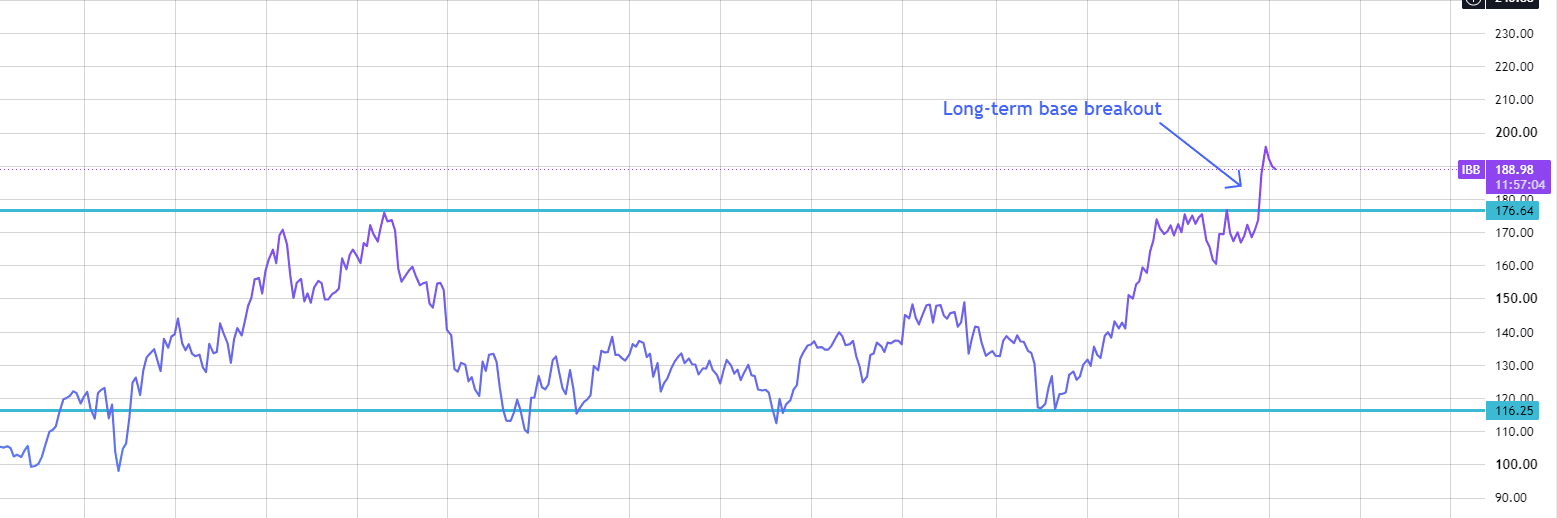
Here is where the story gets interesting for anyone who reads price charts before earnings calls. IBB spent roughly four years, from 2021 through early 2025, building what technicians would call a large base, repeatedly testing resistance and failing to hold above it.
That base was tested again as recently as April 2026, when the index bottomed following the announcement of new tariff measures, an air pocket that turned out to be the final washout before the move.
From that April low, IBB has run to fresh highs, decisively clearing the multi year ceiling that had capped the sector since 2021.
UBS biotech analyst Michael Yee described the current dealmaking driven move as an "extreme technical breakout" in a July 8, 2026 interview, and the iShares Biotechnology ETF (IBB) has been trading within striking distance of its own all time high through mid July.
A clean break above a multi year base, confirmed by heavy M&A driven volume, is exactly the kind of technical setup that tends to attract trend following capital on top of the fundamental buyers already in the sector.
Stock Level Read Through
Within the sector, three groups stand out. Large cap acquirers such as Eli Lilly (LLY) and Amgen (AMGN) are compounding on the back of both organic pipeline strength and aggressive deal activity, with Lilly's obesity and immunology franchises still expanding.
Vertex Pharmaceuticals (VRTX) has confirmed its own breakout on strong commercial uptake of its non opioid pain therapy and gene therapy franchise. In gene editing, CRISPR Therapeutics (CRSP), Intellia Therapeutics (NTLA), and Beam Therapeutics (BEAM) have all shown strong buy signals and rising volume, though these names carry meaningfully higher volatility and remain pre profitability.
Not every name is participating: Regeneron (REGN) has been a notable laggard through mid 2026 following disappointing trial readouts, a useful reminder that a sector wide breakout does not lift every stock equally.
Limits of this analysis
Several of the names driving the rally, including Illumina and select gene editing stocks, are already flagged by momentum screens as overbought, with RSI readings above 70 in some cases. A pullback after a run this sharp would not be unusual.
Regulatory uncertainty has not disappeared. Turnover at the FDA and CDC, restructuring at HHS and NIH, and ongoing debate over vaccine policy remain live risks that could reintroduce volatility with little warning.

