


Ireland-domiciled UCITS ETFs pay a 15% US withholding tax on dividends from US stocks, under the US-Ireland tax treaty.
The US deducts it before the dividend reaches the fund, so it never shows up in your account, and Ireland charges no further withholding tax to foreign investors.
By comparison, Indian investors holding US stocks or ETFs directly pay 25% under the India-US DTAA.
If you are an Indian investor choosing between the two, 15% versus 25% looks like an easy decision. But few investors know what happens to that 15% after it is deducted: whether it can be refunded, and how it affects their tax in India.
And the answer changes the decision. Accumulating UCITS ETFs do come out ahead. But distributing UCITS ETFs can end up costing you more than the US ETF you were trying to avoid, because of how India taxes the dividends they pay out.
This guide explains how the 15% works, why the share class you choose decides whether it actually saves you money, and how to claim credit in India for the 25% withheld on US ETFs.
Table of content
- What is dividend withholding tax?
- Why do Ireland-Domiciled ETFs pay only 15% US withholding tax?
- Does the 15% treaty benefit apply to non-US equity ETFs?
- Is 15% always better than 25%?
- Ireland-Domiciled ETFs vs US-Domiciled ETFs
- Common misconceptions
- How to claim credit for the 25% withheld on US ETFs
- About Paasa
What Is Dividend Withholding Tax?
Dividend withholding tax is a tax deducted from dividends before they are received by an investor (an individual investor or a fund).
For ETFs, this tax is typically applied at the fund level.
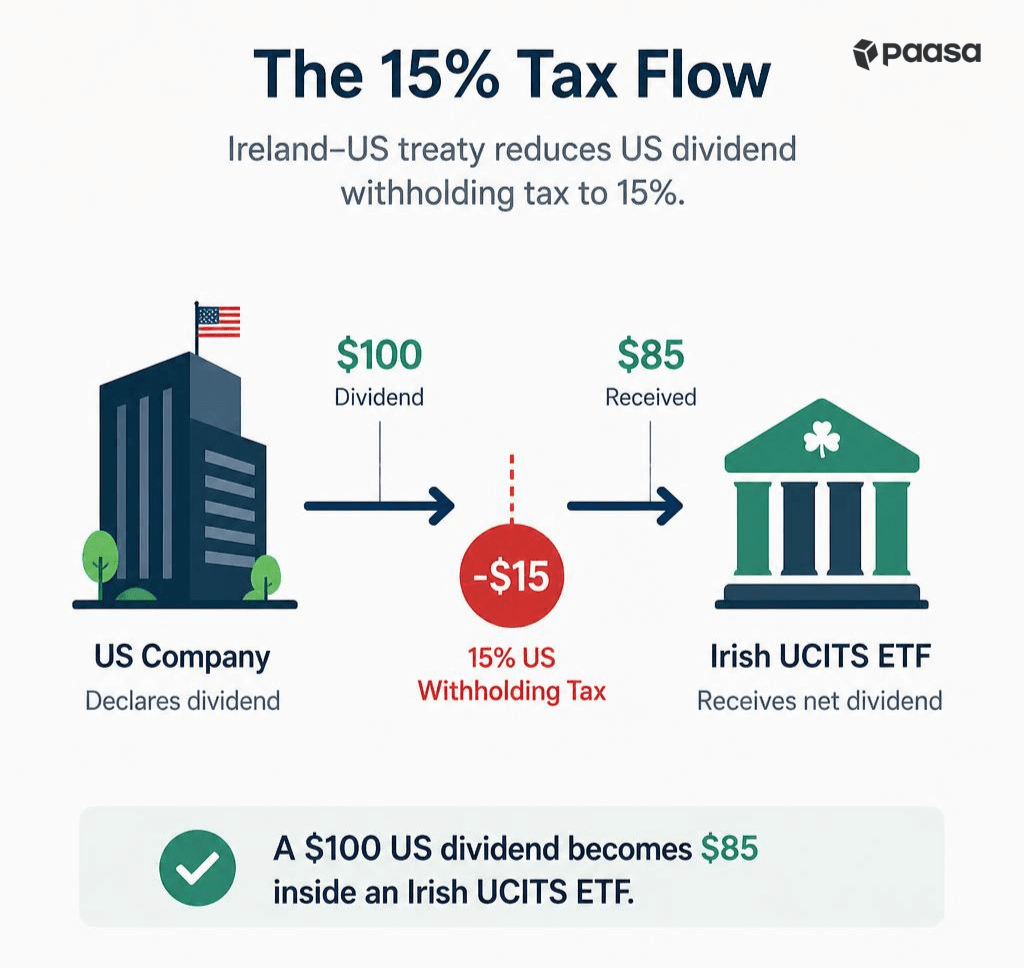
For example, an Ireland-domiciled ETF investing in US stocks is subject to a 15% US withholding tax on dividends received from US companies under the US-Ireland tax treaty.
As a result, if the underlying stocks generate $100 in dividends, the ETF receives $85 after withholding tax.
Why Do Ireland-Domiciled ETFs Pay Only 15% US Withholding Tax?
How the Ireland-US Tax Treaty Creates This 15% Rate
The 1997 United States-Ireland Income Tax Treaty reduces the standard U.S. dividend withholding tax rate from 30% to 15% for qualifying Irish residents.
Ireland-domiciled UCITS ETFs are treated as Irish tax residents for treaty purposes, which allows them to benefit from the reduced 15% U.S. withholding tax rate on dividends from U.S. companies.
The total tax liability for Irish UCITS ETFs on this US dividend income is also 15%, which is paid in form of this withholding tax.
How the 15% Withholding Tax Is Applied Inside the ETF
When an Ireland-domiciled ETF receives dividends from U.S. stocks, the withholding tax is deducted before the cash reaches the fund.
So if the underlying U.S. holdings generate dividend income, the ETF receives only the amount left after the 15% tax has been withheld at source.
Ireland does not charge any withholding tax on distributions from Irish UCITS ETFs to non-Irish investors. So, the end investor does not have to deal directly with any dividend withholding tax.
Does the 15% Treaty Benefit Apply to Global and Non-US Equity ETFs?
If an ETF holds stocks from multiple countries, the 15% treaty rate applies only to dividends paid by U.S. companies.
Dividends from companies in other countries are taxed under those countries’ own withholding rules and treaties, which vary by market.
As a result, a global ETF’s effective withholding tax rate is a blend of different tax regimes rather than a flat 15%.
Is 15% always better than 25%?
No. It depends on whether you can claim the US tax back in India, and that depends on the type of ETF you hold.
Your US dividends can be taxed in up to three places: by the US (25% from you, or 15% from the fund), by Ireland (nothing, for non-Irish investors), and by India (on dividends you receive, or on gains when you sell). India lets you subtract the US tax you paid, but only tax that was deducted from you, not tax paid by a fund.
Example: Suppose each of these ETFs earns $100 in dividends from US stocks in a year. We assume your total Indian tax rate is 30%.
| US ETF (e.g., VOO) | Distributing UCITS (e.g., VUSA) | Accumulating UCITS (e.g., VUAA) | |
| US withholding tax | $25 (25%, deducted from you) | $15 (15%, paid by the fund) | $15 (15%, paid by the fund) |
| Can you claim the US tax in India? | Yes, through Form 67 | No | No |
| Dividend that reaches you | $75 | $85 | $0 ($85 reinvested in the fund) |
| Indian tax this year | $5 (30% × $100 = $30, less $25 credit) | $25.50 (30% × $85) | $0 (taxed only when you sell) |
| Total tax this year | $30 ($25 + $5) | $40.50 ($15 + $25.50) | $15 |
The result: The 15% rate only helps with an accumulating UCITS ETF
- Accumulating UCITS: Only the 15% is paid. The remaining $85 stays invested, and you pay tax on it only when you sell.
- US ETF: You pay 25% in the US and the remaining 5% in India, so your total tax is your slab rate.
- Distributing UCITS: This costs the most. You pay 15% inside the fund, then 30% Indian tax on what is left, with no credit for the 15%.
Ireland-Domiciled ETFs vs US-Domiciled ETFs: Tax Comparison
For Indian investors seeking exposure to US equities, the choice is often between a US-domiciled ETF and an Ireland-domiciled UCITS ETF.
While both may hold the same underlying stocks, their tax treatment can be very different.
| Aspect | US-Domiciled ETF | Ireland-Domiciled UCITS ETF |
|---|---|---|
| US Dividend Withholding Tax | 25% as per the India-US DTAA | 15% at the fund level under the Ireland-US treaty |
| Can you claim it in India? | Yes, as a foreign tax credit through Form 67 | No, the fund pays it, not you |
| US Estate Tax Exposure | Applies above USD 60,000 of US-situs assets | No US estate tax exposure on the ETF itself |
| Accumulating Share Classes | Unavailable | Available |
| Dividend Tax Events | Dividends are typically paid out to investors | Dividends can be automatically reinvested through accumulating structures |
Common Misconceptions About Ireland-Domiciled ETF Withholding Tax
Ireland-domiciled ETFs do not pay any US withholding tax.
Not quite. The Ireland-US tax treaty reduces the fund-level withholding tax on US dividends to 15%, but it does not eliminate it.
The 15% rate applies to all dividends received by the ETF.
No. The treaty benefit applies to dividends from US companies. Dividends from other countries are subject to their own withholding tax rules and treaty networks.
Accumulating ETFs avoid withholding tax because they do not distribute dividends.
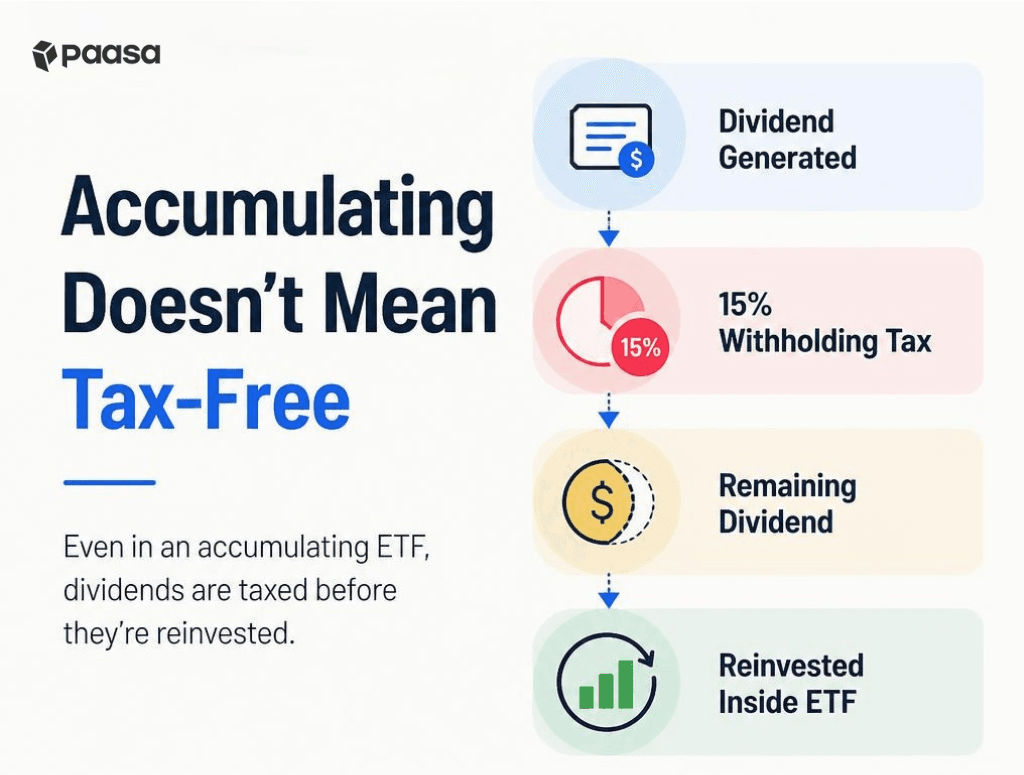
Accumulating ETFs still receive dividends from the underlying companies they hold. The withholding tax is deducted before those dividends are reinvested inside the fund.
Investors can reclaim the 15% withholding tax from the IRS.
No. The withholding tax is deducted at the ETF level before the dividend reaches investors, so investors cannot reclaim it directly from the IRS. It also cannot be claimed as a foreign tax credit in India.
The 15% treaty benefit guarantees higher returns.
The treaty reduces dividend tax leakage, but overall returns will still depend on market performance, fees, and the ETF's investment strategy.
How to claim credit for the 25% withheld on US ETFs
If you hold US stocks or US ETFs, you can claim the 25% US tax as a foreign tax credit in India. This is done through Form 67.
1. Get proof of the tax withheld
Download Form 1042-S or the annual tax statement from your broker. It shows your gross dividends and the US tax withheld.
2. File Form 67 on the income tax portal
Enter your foreign income and the tax withheld, and attach the proof. File it before you file your ITR, and no later than the end of the assessment year (31 March 2027 for income earned in FY 2025-26).
3. Report the same figures in your ITR
Show the dividend in Schedule FSI and the credit in Schedule TR of your ITR. These figures must match Form 67, or the credit may be denied.
Note: Your credit cannot be more than the Indian tax on that income. If your tax rate is 20%, you can claim only $20 of the $25 withheld on $100 of dividends, and the rest is lost. Also, from FY 2026-27, Form 67 is replaced by Form 44 under the Income-tax Act, 2025.
Common mistakes
- Not filing Form 67, or filing it late: You lose the credit and pay Indian tax on top of the 25%.
- Not submitting Form W-8BEN: Without a W-8BEN on file with your broker, the US withholds 30% instead of 25%. The extra 5% is above the treaty rate and generally cannot be claimed in India.
- Mismatched figures: If Form 67 and your ITR show different amounts, the credit can be denied.
- Claiming the 15% paid by a UCITS ETF: This is not allowed. The fund paid the tax, not you, so there is nothing to claim.
About Paasa
Paasa is an Indian investor’s gateway to global investing, trusted by HNIs, family offices, and institutions to diversify into markets across the US, Europe, China, Japan, and beyond.
What sets Paasa apart is its India-facing compliance layer:
- FEMA and LRS compliance embedded into every transaction.
- Tax reporting and analytics built for Indian investors (LTCG, STCG, dividend tax, TCS tracking).
- End-to-end support for remittance structuring, reconciliation, and compliance queries.
Whether it’s equities, ETFs, UCITS funds, managed strategies, or even helping you protect your RSUs from estate tax, Paasa provides a single transparent platform for global portfolios with the confidence that India-specific compliance is taken care of.

