

If you have US stocks sitting at a broker you can no longer use, or you want to move your holdings to a platform better suited to your needs as an Indian investor, you don't have to sell everything to make the switch.
ACATS is a stock transfer system for US stocks that moves your shares from one broker to another without selling them. Your shares simply show up at the new broker, with the same cost basis and purchase date they had before.
This guide explains what ACATS is, how it works, what it costs, and what it means for your Indian taxes.
Table of contents
- What is ACATS?
- How does an ACATS transfer work?
- What can you transfer through ACATS?
- Will I owe Indian capital gains tax on the transfer?
- Why this matters for Indian investors specifically
- Common questions
- About Paasa
What is ACATS?
ACATS stands for Automated Customer Account Transfer Service. It's the electronic system that moves brokerage account assets from one US broker to another, entirely without selling them.
It's run by the National Securities Clearing Corporation (NSCC), a subsidiary of DTCC. Before ACATS, switching brokers meant weeks of paperwork and often liquidating your portfolio. Today, a clean transfer takes 5 to 7 business days and is almost entirely automated.
How does an ACATS transfer work?
Here is what happens from start to finish:
- You open an account at your new broker
- You fill out a Transfer Initiation Form (TIF) at the new broker, with details of your old account
- The new broker submits the request through ACATS, which notifies your old broker
- The old broker has 1 business day to validate the request or flag an issue
- Once validated, the old broker has 3 business days to deliver the assets
- The shares and cash settle into your new account
You don't need to call your old broker or inform them in advance. The new broker handles everything. Your old broker is legally required to cooperate and expedite the transfer.
How long does it take?
Most transfers of US stocks and ETFs complete in 5 to 7 business days.
Complex situations such as name mismatches or unusual assets can stretch to 2 to 3 weeks.
Note: your account is frozen at both brokers during the transfer. You cannot place trades, modify positions, or withdraw cash until settlement completes. Do not initiate a transfer around an earnings announcement, a dividend record date, or an option expiry date.
What can you transfer through ACATS?
These assets transfer in-kind (the actual shares move without being sold):
- US-listed stocks
- US-listed ETFs
- US Treasuries, corporate bonds, and municipal bonds
- Options
- Mutual funds
- Cash
These cannot move through ACATS:
- Fractional shares of stocks and ETFs (your broker will sell these and transfer the cash proceeds)
- Proprietary mutual funds the new broker does not carry
- Certain OTC and micro-cap stocks the new broker won't accept
- Cryptocurrencies
Also, the broker you are moving to must support the asset type. For example, you cannot transfer options to a platform like Paasa or IBKR India as trading in foreign derivatives is prohibited under current Indian regulations.
One important point for investors with globally diversified portfolios: ACATS is US-only infrastructure. Other assets like UCITS ETFs or UK-listed shares on the LSE cannot move through ACATS. They use separate international transfer systems, which we cover separately.
What does it cost?
The receiving broker charges nothing for an incoming transfer. The outgoing fee is charged by your old broker. Here is what the most common platforms charge:
| Broker | Full transfer | Partial transfer |
|---|---|---|
| Charles Schwab | $50 | $0 |
| Fidelity | $0 | $0 |
| Vanguard | $100 | $100 |
| Interactive Brokers | $0 | $0 |
| IndMoney | $65 | $65 |
| Vested | $65 | $65 |
Will I owe Indian capital gains tax on the transfer?
No.
Under Section 5 of the Income Tax Act, 2025, capital gains tax applies when you sell a capital asset. Moving shares between two brokers is a custody change, not a sale. You have not realised any gain, so there is nothing to tax.
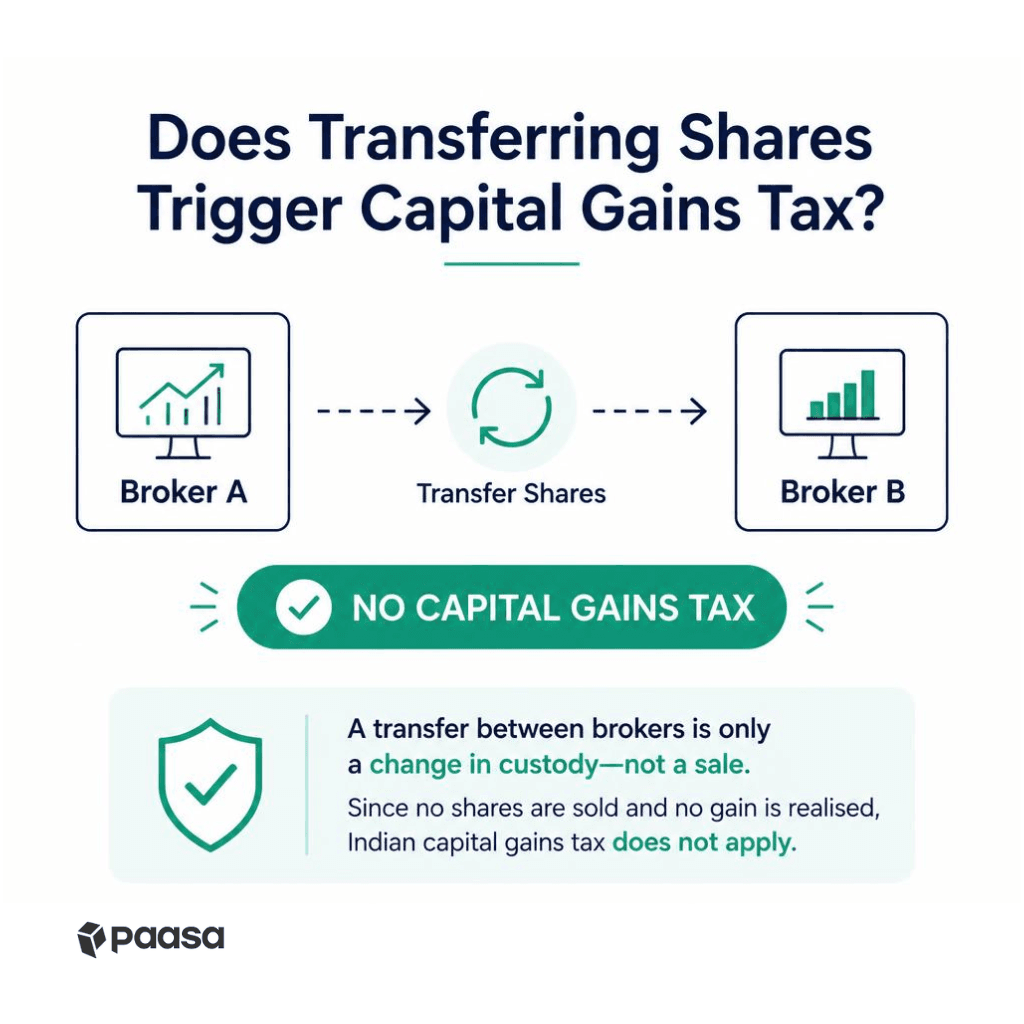
Your original purchase date and purchase price carry over to the new broker, and the capital gains clock continues from where it left off.
The only exception is fractional shares that get liquidated during the transfer. These create a small taxable event on the fractional portion only.
Does my cost basis transfer too?
Yes. ACATS includes a Cost Basis Reporting Service (CBRS) that transmits your original purchase price, purchase date, and tax lot details to the new broker (if both the new and old broker supports CBRS). This data can take up to 30 days to fully populate after the transfer settles.
When you eventually sell, your Indian ITR requires the USD acquisition cost converted to INR at the historical exchange rate per Rule 115 of the Income Tax Rules.
Without correct cost basis at the new broker, you'd have to reconstruct every position manually from old statements.
Before you initiate any transfer, download a complete cost-basis report from your old broker and keep it as a backup.
Why this matters for Indian investors
For Indian investors, ACATS solves two specific problems.
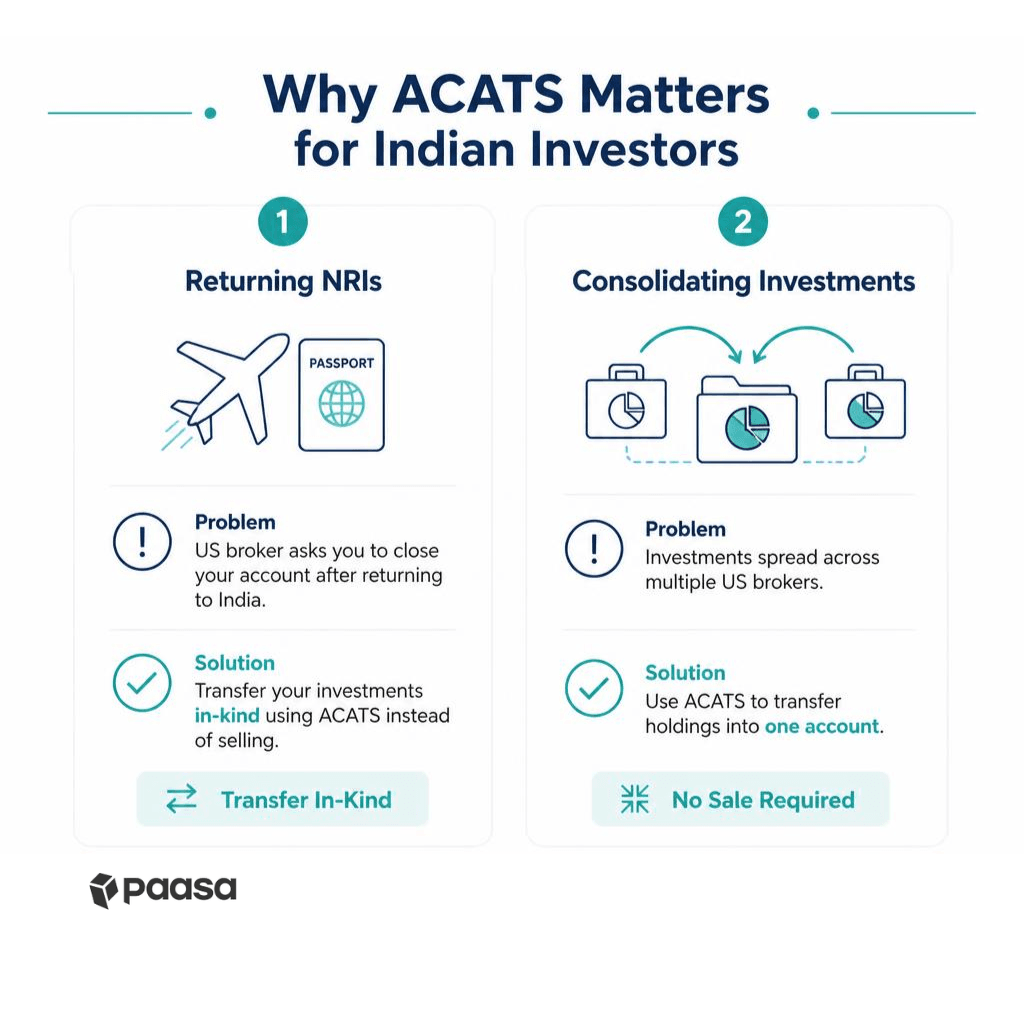
For returning NRIs who can no longer hold their US accounts
Many US brokers close accounts when account holders become non-US residents. If you've returned to India and your US broker has asked you to close your account, selling everything is not your only option. You can transfer your holdings to a broker that supports Indian residents without triggering a capital gains event on positions that may have appreciated significantly over the years.
This is one of the most financially meaningful applications of ACATS for Indians. Selling a $100,000 portfolio with $50,000 of long-term gains to satisfy a broker's residency policy would cost roughly $6,250 in Indian LTCG tax at 12.5%. Transferring in-kind costs $50 to $100.
For investors consolidating across platforms
Many Indian investors end up with US holdings scattered across multiple platforms from their time abroad and investments made since returning. Consolidating these via ACATS typically costs $50 to $100 in outgoing fees, often reimbursed, and takes less than two weeks. Selling and rebuying would mean paying Indian capital gains tax on every appreciated position, plus using up LRS headroom for what is essentially a housekeeping exercise.
Note: India-domiciled brokers are not NSCC members and cannot receive ACATS transfers directly. If you want your US holdings on an India-facing platform, the underlying broker has to be a US firm.
Why transfers sometimes get rejected
The most common reasons for rejection are:
- A name mismatch between accounts (your full legal name at one broker, a shortened version at the other)
- A wrong account number
- Mismatched account types (joint vs individual)
- An incorrect tax ID
- Non-transferable assets included in the request
The carrying broker has 24 hours to issue a soft reject (you fix the issue and resubmit) or a hard reject (you start the process over from scratch).
To minimise the risk of rejection:
- Make sure both accounts are in your exact full legal name with a matching tax ID
- Ask the new broker in writing whether they will accept every position you hold before initiating
- If you have any unusual or illiquid positions, run a partial transfer first
What ACATS does not solve
ACATS handles your US-listed holdings cleanly. It does not handle:
- UCITS ETFs and other non-US-listed securities, which need separate international transfer instructions
- Conversion of your historical cost basis into INR at Rule 115 rates for your ITR
- LRS documentation, TCS reconciliation, FEMA compliance, and Schedule FA disclosure
These are the administrative layers that Indian investors typically have to manage manually at broker-only platforms.
At Paasa, the transfer process is handled inside the app. Transfer instructions for every major US broker are available directly, and cost basis is reconciled for Indian tax reporting. If you are holding US stocks across multiple platforms and want to consolidate, you can do it without selling, without paying capital gains tax, and without touching your LRS limit for the year.
Common questions Indian investors have around ACATS
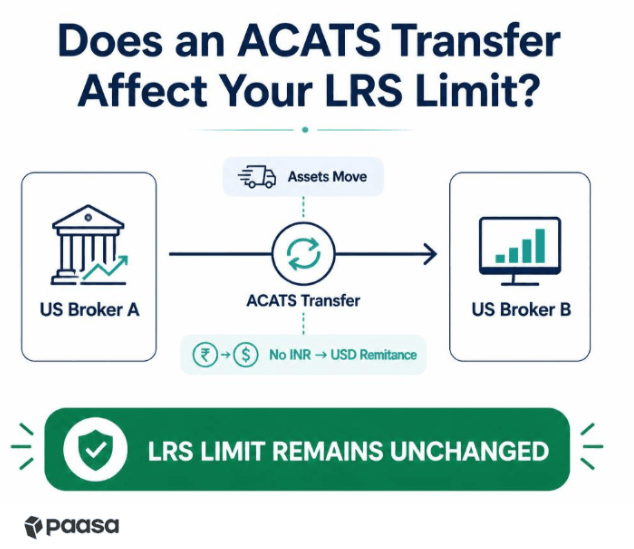
Will a broker switch affect my LRS limit for the year?
No. ACATS moves assets that are already held in the US. There is no INR-to-USD conversion and no fresh remittance involved. Your $250,000 annual LRS limit is completely untouched.
Do I need to report an ACATS transfer in my ITR?
No separate disclosure is required for a custody change. There is no capital gain to report because you haven't sold anything.
Your Schedule FA foreign asset disclosure (if you are an ROR filer) reports your holdings as of 31 December of the financial year regardless of which broker holds them on that date, so a mid-year transfer doesn't change what you disclose.
The broker you hold the assets with at year-end is the one that appears in Schedule FA.
Can I transfer only some of my positions, not all of them?
Yes. This is called a partial transfer. You specify exactly which positions to move, and your old account stays open with the remaining holdings. This is useful if:
- You have proprietary funds or fractional positions at the old broker that can't transfer
- Your RSUs are still vesting at a US employer's stock plan linked to that account
- You want to test the process before moving everything
Most major US brokers support partial transfers. Some charge a lower or zero fee for partials compared to a full transfer.
What happens to dividends that arrive during the transfer?
Dividends declared before the transfer date are received at the old broker first and then swept to the new account in a residual transfer, typically within 30 days of the main settlement completing.
What if I have RSUs at a US employer stock plan?
Vested RSUs are your shares and can be transferred. Most employer stock plan accounts use a DTC Free of Payment transfer rather than ACATS, because stock plan accounts don't always participate in ACATS the same way a standard brokerage account does.
The end result is the same: an in-kind transfer with no taxable event. Unvested RSUs cannot be transferred and stay with the employer's stock plan provider.
How to transfer to Paasa
Step-by-step transfer instructions for every major global broker is available in the Paasa app.
Simply download the app, complete your sign-up, and follow the in-app guide to initiate your in-kind transfer. Our team handles the documentation and coordinates with your existing broker on your behalf to ensure a smooth transition.
If you need any assistance regarding the transfer process, feel free to contact us directly at paasa@support.com or contact us via WhatsApp at +91 98710 76013.
About Paasa
Paasa is a global investing platform built for Indian HNIs, family offices, and institutions. We provide direct access to markets across the US, UK, Europe, Switzerland, and Asia, with an India-facing compliance layer built in from the ground up.
What that means in practice:
- FEMA and LRS compliance embedded into every transaction
- Tax reporting and analytics calibrated for Indian investors, covering LTCG, STCG, dividend withholding
- End-to-end support for remittance structuring, cost basis reconciliation, and Schedule FA disclosure
- In-app transfer guides for every major US broker, so you can move your existing holdings to Paasa without selling
Whether you're a returning NRI consolidating accounts from your time abroad, or an investor looking for better compliance support and access to global markets beyond just the US, Paasa is built for exactly that.

