

If you want to invest in the Nasdaq 100 from India, there is more than one way to do it. You can buy an Indian fund of fund in rupees, buy the Nasdaq 100 ETF listed on the NSE, or remit money abroad under LRS and buy a US-listed or UCITS ETF directly.
Most investors end up narrowing this down to a choice between two: the Motilal Oswal Nasdaq 100 Fund of Fund, the largest rupee route, and a UCITS Nasdaq 100 ETF, the most popular direct route with the most tax advantages.
The Motilal Oswal Nasdaq 100 Fund of Fund is an Indian mutual fund that invests in units of the Motilal Oswal Nasdaq 100 ETF, which in turn holds the Nasdaq 100 stocks. It was launched in November 2018, is bought in rupees with a minimum investment of Rs 500, and manages over Rs 8,500 crore.
The iShares Nasdaq 100 UCITS ETF (CNDX) is an Ireland-domiciled ETF that holds the same 100 companies directly. It was launched in January 2010, manages over EUR 24 billion, and reinvests all dividends automatically. Indian investors buy it in dollars through the RBI's Liberalised Remittance Scheme (LRS) and hold the units directly in their own name.
Both give you the same 100 companies. The difference is everything around them: what you pay each year, how you are taxed, what you must disclose, and whether the fund will even accept your money next month. This blog walks through each of those differences so you can decide which route fits your situation.
What both routes give you
- The same index. Both track the Nasdaq 100, which holds the 100 largest non-financial companies on the Nasdaq.
- Reinvested dividends. The FoF's growth option and accumulating UCITS ETFs like CNDX both reinvest dividends.
- No US estate tax exposure. Neither route holds US-listed securities in your name. The FoF is an Indian mutual fund, and Ireland-domiciled UCITS ETFs are exempt from the US estate tax that applies to US-listed ETFs above USD 60,000. If estate tax is your main concern, both routes solve it.
So the choice is not about the index or estate tax. It is about structure, cost, access, and compliance.
The structural difference: a wrapper vs direct ownership
The Motilal Oswal FoF is a fund that buys another fund. Your money goes into the FoF, the FoF buys units of the Motilal Oswal Nasdaq 100 ETF, and the ETF buys the stocks. You hold units of an Indian mutual fund in rupees.
With a UCITS ETF, you remit dollars abroad under LRS and buy the ETF directly on an European exchange such as the London Stock Exchange. The units sit in your own brokerage account, held with a global custodian, in your name.
This wrapper-versus-direct distinction is what drives the differences covered next.
Cost comparison: the two-layer problem
The FoF's disclosed expense ratio looks cheap, but it is only one of two layers you pay: the FoF charges its own expense ratio, and the underlying Motilal Oswal Nasdaq 100 ETF charges its own expense ratio inside that.
| Motilal Oswal Nasdaq 100 FoF | iShares Nasdaq 100 UCITS ETF (CNDX) | |
|---|---|---|
| Fund expense ratio | 0.16% (direct) / 0.47% (regular) | 0.30% TER, all-in |
| Underlying ETF expense ratio | ~0.59% (Motilal Oswal Nasdaq 100 ETF) | Not applicable, holds stocks directly |
| Total recurring cost | ~0.75% (direct) / ~1.06% (regular) | 0.30% |
| Exit load | 1% if redeemed within 15 days | None |
| One-time costs | None | Remittance and FX conversion charges, brokerage |
To be fair to the FoF route: the UCITS route has a one-time cost the FoF does not, as your bank charges for the outward remittance and takes a spread on the conversion.
Note: The FoF's costs are deducted inside the NAV rather than shown as a line item, but both layers are still charged on your invested amount every year.
Performance: how each fund tracks its index
Since the FoF's returns are in rupees and a UCITS ETF's returns are in dollars, comparing their return numbers head to head is misleading.
Rupee depreciation inflates the FoF's INR returns the same way it would inflate yours in the UCITS route.
The honest comparison is how well each vehicle tracks its own benchmark.
The Motilal Oswal FoF is benchmarked to the Nasdaq 100 Total Return Index. Its tracking gap comes from three sources stacked together: the FoF's expense ratio, the underlying ETF's expense ratio and its own tracking error, and the cash the FoF holds for liquidity (its mandate allows up to 5% in debt and cash).
The FoF has delivered an annualised return of 24.55% over five years in INR terms as of June 2026, but check its factsheet for the gap against the Nasdaq 100 TRI over the same period, because that gap is the real cost of the structure.
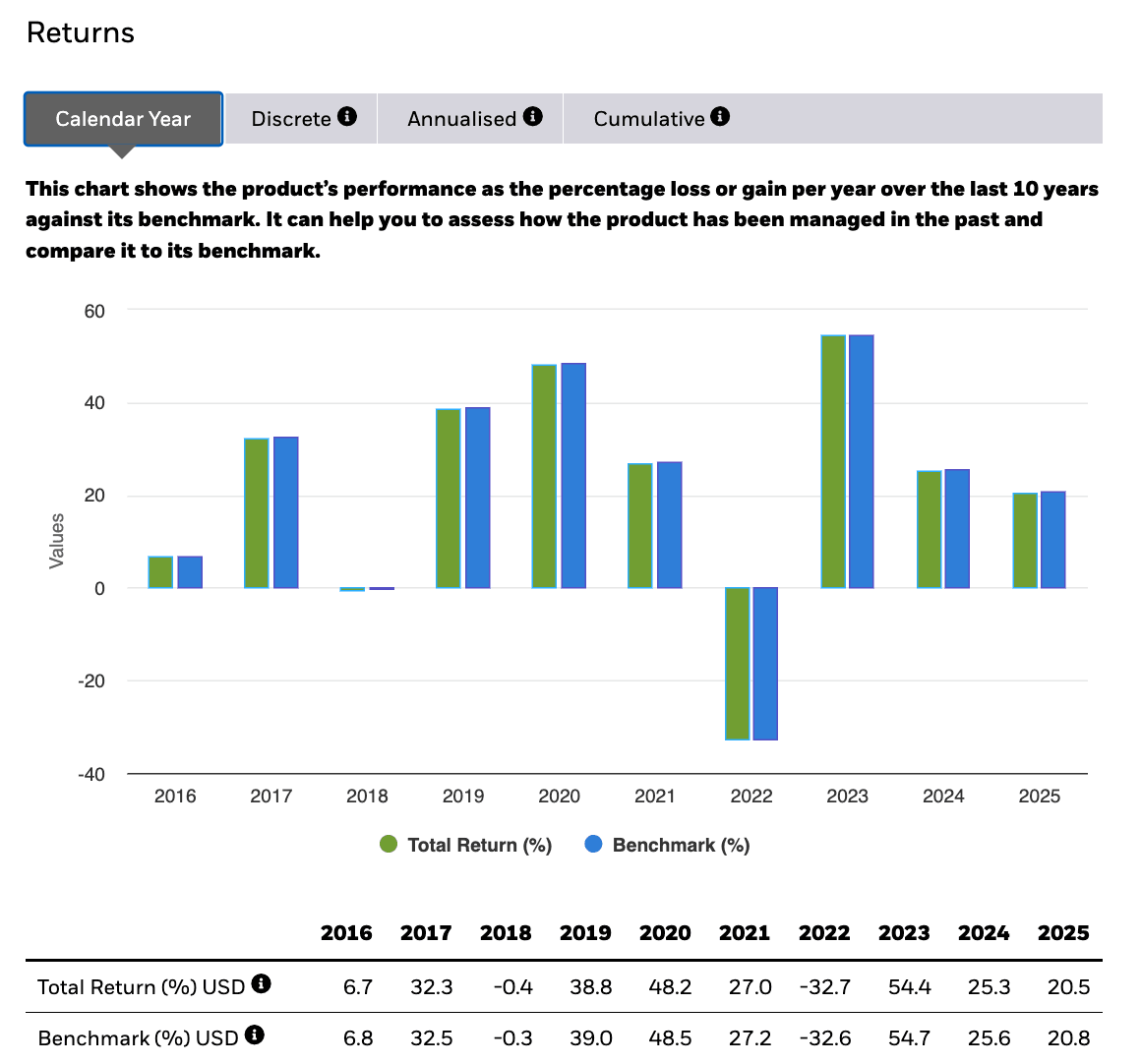
CNDX has a single layer between you and the index, the 0.30% TER. Large UCITS Nasdaq 100 ETFs have historically tracked their index with a gap close to, and sometimes tighter than their TER.

Why does the FoF keep restricting subscriptions?
SEBI caps the entire Indian mutual fund industry's overseas investments at USD 7 billion, with a separate USD 1 billion cap for overseas ETFs. When the industry hits the cap, fund houses must stop taking fresh money.
Fresh flows to Motilal Oswal Nasdaq 100 FoF were suspended in early 2022 when the industry breached the limit. The fund later reopened with a cap of Rs 2 lakh per PAN per calendar month.
In April and May 2026, Axis, Kotak, and Nippon India all paused or restricted fresh inflows into their overseas schemes as the industry again ran out of headroom.
As of early 2026, only around 28 international mutual funds and 6 international ETFs were open for fresh investment.
What this means for you in practice:
- Fresh lumpsum investments and new SIP registrations get paused when the industry cap is breached, and even after reopening, lumpsum deployment can stay capped, which makes any meaningful deployment slow.
- Whether fresh investment reopens next month depends on other investors redeeming, which you cannot predict.
The UCITS route does not have this problem. Your LRS limit of USD 250,000 per financial year is your own individual limit under RBI rules. It does not depend on what other investors do.
Already hold the FoF? What switching involves
If you already hold the FoF, switching is a decision to make deliberately, not in a rush. Three things to know:
1. Redeeming triggers capital gains. Selling your FoF units is a taxable event. Units held over 24 months are taxed at 12.5% LTCG; units held under 24 months are taxed at your slab rate. If you have large short-term gains, it may be worth waiting for them to turn long-term before moving.
2. There is no in-kind path from a mutual fund. Unlike moving US-listed stocks between brokers, mutual fund units cannot be transferred to a foreign brokerage. The only path is redeem, remit, and repurchase. You can stagger this over months to average out currency conversion and market timing, and to stay within any TCS thresholds you care about.
3. TCS applies above Rs 10 lakh per year. Remittances under LRS above Rs 10 lakh in a financial year attract 20% TCS. This is not a cost, it is a tax collected in advance that you adjust against your tax liability or claim as a refund when you file, but it does affect your cash flow in the year you move.
Taxation in India
For Indian residents, the tax treatment of the two routes is now broadly similar.
| Motilal Oswal Nasdaq 100 FoF | UCITS Nasdaq 100 ETF | |
|---|---|---|
| Long-term holding period | 24 months | 24 months |
| LTCG rate | 12.5% | 12.5% |
| STCG rate | Slab rate | Slab rate |
| Taxed only on redemption | Yes | Yes (accumulating ETF, no dividend income) |
| Schedule FA disclosure | Not required | Required every year you hold |
| TCS on investment | None | 20% on LRS remittances above Rs 10 lakh per year, adjustable against tax |
The genuine differences are compliance, not rates. The FoF requires nothing beyond your normal ITR.
The UCITS route requires you to disclose your foreign holdings in Schedule FA every year, and non-disclosure carries significant penalties under the Black Money Act. This is an annual obligation you should factor into your decision.
Note: The platform you use might generate a Schedule FA report and an Indian capital gains statement for your holdings each year, which removes most of this work.
Ownership and portability
One more difference matters if you have plans to move overseas.
FoF units are an Indian mutual fund holding, in rupees, inside the Indian mutual fund system. If you move abroad, you will be subject to the rules of your country of residence.
For example, the US will classify Indian mutual funds as a PFIC and subject you to punitive tax rates.
Fresh investments as an NRI will also depend on the fund house's policy for your country of residence.
UCITS ETF units are held in a global brokerage account in your name. If you move from India to US, Dubai, Singapore, or London, the holding moves with you: you update your residency with the broker and carry on.
If you might become an NRI, this portability can matter more to your decision than the cost comparison.
Which route is right for you?
The FoF route fits you if
- You invest small amounts monthly in rupees
- You want zero paperwork and no foreign disclosure
- You can live with the subscription caps.
For a Rs 5,000 monthly SIP, the simplicity has real value, and the cost difference in absolute terms is small.
The UCITS route fits you if
- You are investing a meaningful corpus
- You care about the recurring cost gap compounding over a decade
- You don't want to be subject to arbitrary investment limits and pauses
- There is any chance you will live outside India.
The one-time setup effort and the annual Schedule FA disclosure are the price of direct ownership.
Neither route is wrong. But they were built for different investors, and the FoF's regulatory ceiling means that even investors who prefer it may not always be able to use it.
Switching to Paasa
If you have decided to move some or all of your Nasdaq 100 exposure from the FoF to a UCITS ETF, Paasa handles the parts that usually cause friction:
- Staggered redemption support: Plan your FoF redemptions in tranches to manage the capital gains and currency conversion timing yourself, rather than moving everything in one step.
- Seamless funding and LRS: Remit, convert, and buy the UCITS ETF in one flow, with LRS compliance handled within the platform.
- Compliance advantage: Get Schedule FA reports and Indian capital gains statements generated for you at tax time, for the new holding and for the FoF units you redeemed.
Paasa is a SEBI-registered platform (Arc Spire Advisory Pvt Ltd, INA000021058) built for Indian investors going global.

