

If you're an Indian professional working in companies like Microsoft, Apple, Google, etc, your employer stock grants can become a large part of your wealth over time as they vest and appreciate.
While RSUs can build wealth, they also create concentration risk. A large allocation to one company or sector means your portfolio depends heavily on its performance.
Deciding when and how to diversify is therefore an important part of managing your finances. This guide explains why concentration risk matters and how to reduce it effectively.
Table of Contents
- Why Concentration Risk Matters
- When Should You Start Diversifying Your RSUs?
- How to Reduce Concentration Risk
- Tax Considerations When Selling RSUs
- About Paasa
Why Concentration Risk Matters
Concentration risk occurs when a large portion of your portfolio is tied to a single asset, such as your employer's stock. For many employees, RSUs can grow into a significant part of their wealth over time, increasing reliance on one company's performance.
Concentration risk matters for these key reasons.
- Greater portfolio volatility: As your allocation to employer stock increases, your portfolio becomes more sensitive to movements in a single stock. This means changes in your company's share price can have a larger impact on your overall portfolio compared to a more diversified allocation.
- Double exposure to the same company: Your income, future RSU grants, bonuses, and investments may all depend on your employer. If the company underperforms, both your employment income and investment portfolio can be affected simultaneously.
For example, suppose your investment portfolio is worth $1,000,000 and 40% ($400,000) is invested in your employer's stock.
If your employer's share price falls by 30%, your employer stock would lose $120,000 in value, reducing your overall portfolio by 12%, even if all your other investments remained unchanged.
By comparison, if employer stock represented only 10% of your portfolio, the same decline would reduce your overall portfolio by just 3%.
Even if the broader market performs well, your portfolio can underperform simply because one company or one sector has performed poorly.
Why Concentration Matters for Estate Planning (US Estate Tax)
As your holdings grow, both your concentration risk and the value of your US-situs assets increase. This means a larger portion of your wealth is exposed not only to the performance of a single company but also to the potential impact of US estate tax.
For investors who have accumulated substantial holdings in US-listed company stock, US estate tax becomes another reason to diversify.
Unlike capital gains tax, which applies when you sell your shares, US estate tax applies if you pass away while still holding certain US-situs assets, including shares of US-listed companies.
Non-US residents receive a flat credit of US$13,000 against the tax, which is what shelters the first US$60,000 of estate value. Once your US-situs assets exceed that threshold, your estate is subject to US estate tax under the applicable rate schedule, with the highest marginal rate reaching 40%.
Example
Suppose you are a software professional working in the US. Your total US assets, including stock market investments and other US-situs property, amount to $1,000,000.
The tax is worked out in two steps. The rate schedule is applied to the full value of your US-situs assets to arrive at a tentative tax, and the flat credit is then subtracted from that figure:
- Gross US Estate: $1,000,000
- Tentative tax (rate schedule applied to the full estate): $345,800
- Less unified credit: ($13,000)
- Estate tax payable: $332,800
In this scenario, out of your $1,000,000 hard-earned wealth, the IRS would take $332,800 before your family receives anything.
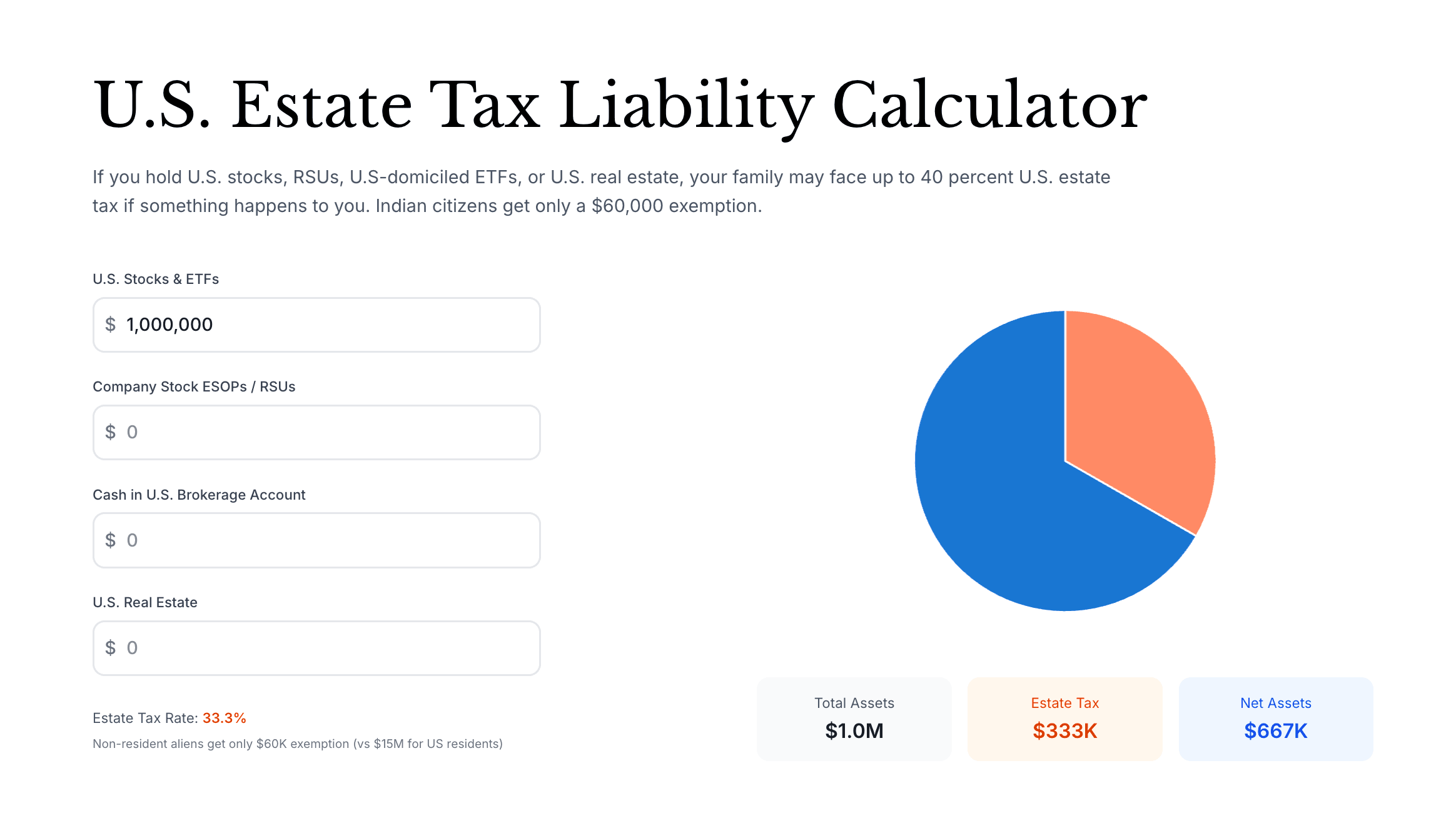
Use our Estate Tax Calculator to find your exact liability.
To learn how US estate tax is calculated in detail, read our guide on How US Estate Tax Works for Indians and NRIs.
When Should You Start Diversifying Your RSUs?
The right time to diversify depends on your overall financial situation, risk tolerance, investment goals, tax considerations, and your conviction in your company's long-term prospects.
Many investors begin reviewing their strategy when their employer's stock becomes a meaningful part of their portfolio, often around the 20-30% range.
It's also important to revisit your allocation whenever new RSUs vest, as your exposure can gradually increase over time.
If you've accumulated a substantial amount of US-listed company stock, consider diversifying once your US-situs assets begin approaching or exceed the US$60,000 estate tax threshold.
As your RSUs grow in value over time, reaching this threshold can be a practical point to reassess both your concentration risk and potential estate tax exposure, and decide whether to gradually reduce your position.
How to Reduce Concentration Risk
Reducing concentration risk is not about selling all your RSUs immediately. Instead, it is about gradually lowering your exposure to your employer's stock and reinvesting the proceeds into a more diversified portfolio.
This process involves two steps: selling shares systematically over time and using the proceeds to build a portfolio spread across different companies, sectors, and geographies.
Sell Your RSUs Systematically to Gradually Reduce Concentration Risk
There isn't a single selling strategy that works for every RSU holder.
The right approach depends on factors such as how much employer stock you've accumulated, whether you're still receiving new RSUs, and how you've managed your holdings so far.
You may need to reduce a large concentrated position while continuing to receive new RSUs.
Or, you may have already diversified your holdings and simply need a consistent plan for handling newly vested shares. In some cases, you may no longer receive additional RSUs but still hold a significant employer stock position that you want to gradually reduce.
Understanding which situation you're in can help you build a selling strategy that aligns with your overall investment goals.
You've accumulated a large employer stock position without diversifying and continue to receive new RSUs
If you've accumulated a significant employer stock position without diversifying and continue to receive new RSUs, you'll likely need a two-part strategy: gradually reduce your existing holdings while putting a plan in place for future vesting events.
As you reduce your existing concentration, your focus will gradually shift to the next situation: managing newly vested RSUs as they continue to vest.
You've already diversified but continue to receive new RSUs
If you've already reduced your employer stock exposure, your priority is maintaining it. As new RSUs vest, you can choose to sell all of the newly vested shares, sell a portion of them, or retain some shares while keeping your employer stock allocation within your target range.
Once you've identified your situation, the next step is determining the right approach to selling your RSUs based on your financial goals, tax considerations, and overall investment plan.
For a step-by-step framework on how and when to sell your RSUs, read our guide on How to Sell RSUs: A Practical Framework for Deciding When to Sell.
Your selling decisions also have tax implications, so it's important to understand how RSUs are taxed throughout their lifecycle. Knowing when your shares are taxed, how your cost basis is determined, and when capital gains tax applies can help you make more informed decisions.
For a detailed explanation, read our guide on RSU Taxation Explained: From Grant and Vesting to Sale
Reinvest the Proceeds Into a Diversified Portfolio
Selling your employer's stock is only one part of reducing concentration risk. The next step is reinvesting the proceeds into assets that provide broader diversification.
Before selling your RSUs, it's worth considering how you'll reinvest the proceeds. Under FEMA, vested RSUs are treated as Overseas Portfolio Investments (OPI), which means the proceeds from selling your shares must either be reinvested overseas or repatriated to India within 180 days.
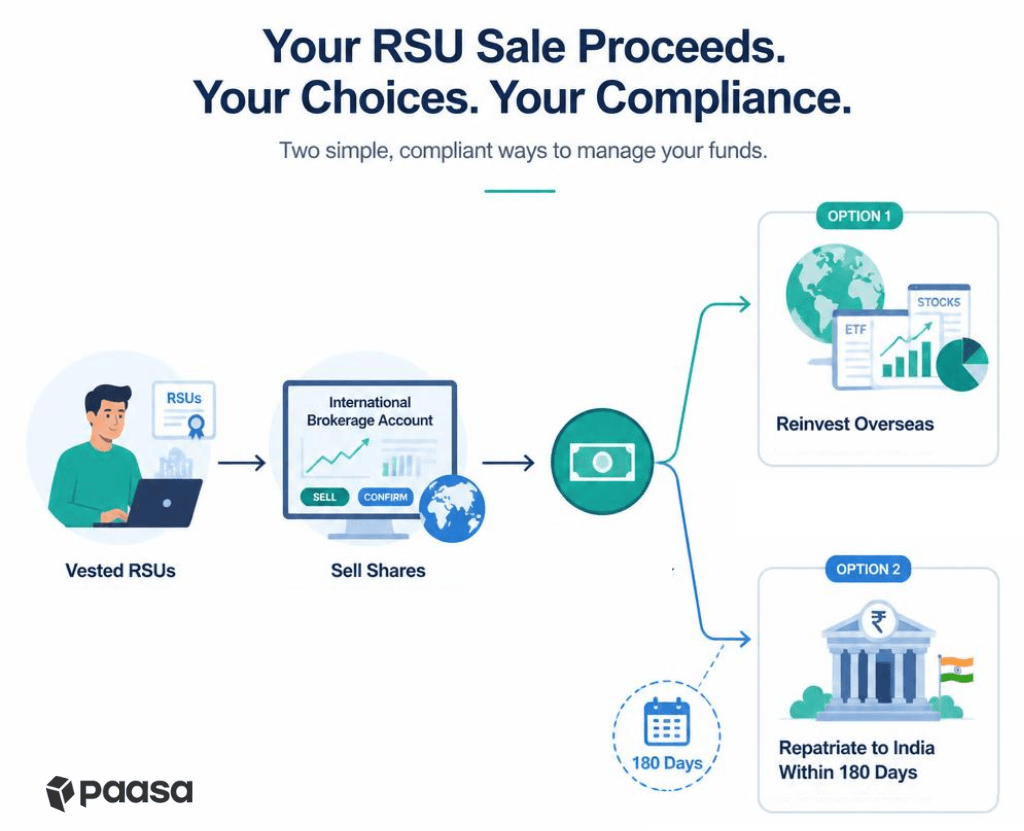
Planning how you'll deploy these funds before selling can help you remain compliant while avoiding idle cash.
To understand how the 180-day rule works and what it means for RSU investors, read our guide on FEMA 180-Day Rule for Overseas Investments.
Depending on your investment strategy, this may include:
- Broad-market ETFs that provide exposure to hundreds or thousands of companies through a single investment.
- Sector ETFs to diversify your portfolio across industries rather than remaining heavily invested in your employer's sector.
- Direct stocks that provide exposure to companies across different sectors and industries, helping reduce concentration in your employer's stock.
- Other asset classes, such as bonds or fixed-income investments, depending on your financial goals and risk tolerance.
The objective is not to eliminate risk entirely, but to avoid having a large portion of your wealth depend on the performance of one company.
Why You Should Use UCITS ETFs for US Market Exposure
For investors seeking long-term exposure to the US market, Ireland-domiciled UCITS ETFs offer a practical alternative to investing in US-listed ETFs directly. They allow you to participate in the performance of leading US companies while avoiding US estate tax risk.
In addition to broad global diversification, UCITS ETFs are often preferred by international investors because they benefit from lower US dividend withholding tax at the fund level (15%, against the 25% an Indian investor pays on US-listed ETFs under the India-US treaty) and offer accumulating share classes that automatically reinvest dividends, making them a tax-efficient choice for long-term investing.
How Paasa Can Help
Paasa helps Indian investors and RSU holders access global markets with ease, enabling investments across the US, Europe, China, Japan, and other major economies.
Trusted by HNIs, family offices, and institutions, Paasa combines international investing opportunities with India-focused support and compliance.
Paasa helps you hold and protect your RSU wealth with:
- In-kind transfer from your existing brokerage account
- Access to US, Europe, China, Japan, and other major economies
- Access to UCITS ETFs that protect against the US estate tax risk
- Comprehensive tax reporting tailored for Indian investors, including capital gains, dividend taxation, and TCS tracking.

