


If you are an Indian professional working in the US, you can become a US tax resident without becoming US domiciled. This creates a unique investment dilemma.
As a US tax resident, you avoid UCITS ETFs because they are classified as Passive Foreign Investment Companies (PFICs), which come with complex tax rules and reporting requirements.
At the same time, you receive only a US$60,000 estate tax exemption on US-situs assets, leaving larger US investment portfolios exposed to estate tax.
Once you return to India and are no longer a US tax resident, the PFIC rules no longer apply, allowing you to invest in UCITS ETFs and other non-US funds without PFIC-related tax concerns.
It also becomes a good time to review your portfolio and consider reducing future US estate tax exposure.
This guide explains what changes after you return to India, why the PFIC rules no longer apply, and whether moving from US-listed investments to UCITS ETFs is the right choice.
Table of contents
- How returning to India changes your US investments
- Should you continue holding your US ETFs and stocks after returning to India?
- When does switching make sense?
- About Paasa
How returning to India changes your US investments
Change in US tax residency
Once you cease to be a US tax resident, the US stops taxing your worldwide income. You then become subject to the tax laws of your new country of residence.
For Indians returning home, this means your worldwide income, including dividends, interest, and capital gains from US and other foreign investments, is taxable in India, subject to Indian tax laws and the India-US DTAA.
PFIC rules no longer apply
As a US tax resident, investing in most non-US funds, including many UCITS ETFs, triggers the Passive Foreign Investment Company (PFIC) rules, resulting in complex tax calculations, reporting requirements, and potentially punitive tax treatment.
Once you are no longer a US tax resident, PFIC rules no longer apply. This allows you to consider investment structures, such as UCITS ETFs, that may previously have been impractical from a US tax perspective.

To understand how the PFIC rules apply to UCITS ETFs and why they matter for US tax residents, read our guide on UCITS ETFs for NRIs: PFIC Rules, U.S. Estate Tax & Returning to India.
US estate tax exposure remains
Many Indians in the US accepted US estate tax exposure to avoid PFIC rules by investing in US stocks and ETFs. As non-US domiciliaries, they receive only a US$60,000 exemption on US-situs assets, with the remainder taxed at progressive rates up to 40%.
Returning to India removes PFIC concerns but not US estate tax exposure. US stocks, ETFs, and other US-situs assets remain subject to estate tax, making this a good time to reassess whether to retain US-domiciled investments or switch to non-US structures like UCITS ETFs.
Taxation and reporting of your US investments in India
Once you become an Indian tax resident, your US investments are subject to Indian tax and reporting requirements. This includes the taxation of dividends and capital gains.
For a detailed explanation of how capital gains on foreign investments are calculated and taxed, see our guide on taxation of foreign capital gains.
Should you continue holding your US ETFs and stocks after returning to India?
Returning to India does not necessarily mean you should sell your US investments.
However, your change in tax residency removes the PFIC constraints that previously influenced your investment choices, making it worthwhile to reassess whether your current portfolio remains the most efficient structure for your long-term goals.
Review your US estate tax exposure
Although you are no longer a US tax resident, US estate tax still applies to US-situs assets such as US stocks and US-domiciled ETFs. As a non-US domiciliary, you are entitled to an estate tax exemption of only US$60,000.
If the value of your US-situs assets exceeds this threshold at the time of death, the estate is subject to US estate tax, with the highest marginal rate reaching 40%.
For investors with substantial portfolios, this can significantly reduce the wealth ultimately passed on to their heirs. Reviewing your estate tax exposure should therefore be an important part of your investment strategy after returning to India.
US ETFs vs UCITS ETFs after returning to India
Once you are no longer a US tax resident, the PFIC rules no longer apply. This means you are free to consider UCITS ETFs without the complex PFIC tax and reporting requirements.
For many returning Indians, the decision becomes a trade-off between continuing to hold US-domiciled investments or restructuring into UCITS ETFs.
| Consideration | US Stocks & US ETFs | UCITS ETFs |
|---|---|---|
| PFIC Rules | Never subject to the PFIC rules, regardless of your US tax residency. | Subject to the PFIC rules while you are a US tax resident. After returning to India and ceasing to be a US tax resident, the PFIC rules no longer apply. |
| US Estate Tax | Subject to US estate tax once US-situs holdings exceed US$60,000; rates can go up to 40% | Not exposed to US estate tax as they are not US-situs assets, reducing inheritance risk |
| Dividend Withholding | 25% US withholding tax for Indian residents under the DTAA, withheld from you and creditable in India | 15% withholding on US dividends at the Irish fund level, borne inside the fund |
| Global Diversification | Similar broad global exposure | Similar broad global exposure |
| Indian Taxation | Taxed under Indian tax laws as foreign investments | Taxed under Indian tax laws as foreign investments |
Example
Suppose that you have returned to India with a US$2 million portfolio invested entirely in US stocks and US-domiciled ETFs, with an original cost basis of US$500,000 (US$1.5 million of unrealised long-term capital gains).
You expect the portfolio to grow at 10% annually over the next 20 years with no additional contributions, withdrawals, or dividend distributions and that your heirs will eventually inherit this.
You are considering two options:
- Scenario 1: Continue holding your existing US investments.
- Scenario 2: Sell the portfolio today, pay the applicable Indian long-term capital gains tax, and reinvest the remaining proceeds into UCITS ETFs.
For scenario 1: Continue holding your existing US investments
You continue holding your US portfolio for 20 years, deferring capital gains tax.
At inheritance, the full value of the portfolio is run through the US estate tax rate schedule, and the flat US$13,000 unified credit available to non-residents is then subtracted from the tax.
| Item | Value |
|---|---|
| Initial amount (A) | $2,000,000 |
| Rate of growth (YoY) | 10% |
| Amount after 20 years (B) | $13,455,000 |
| Tentative tax (rate schedule applied to B) | $5,327,800 |
| Less unified credit | -$13,000 |
| Estate tax liability (C) | $5,314,800 |
| Amount heir finally gets (B - C) (D) | $8,140,200 |
After US estate tax, your heirs receive US$8.14 million, an effective CAGR of ~7.3% over 20 years.
Scenario 2: Sell, pay LTCG tax, and switch to UCITS ETFs
In this scenario, you sell the US portfolio, pay Indian long-term capital gains tax, and reinvest in UCITS ETFs. This reduces the initial investment but avoids US estate tax, allowing the full portfolio value to pass to beneficiaries.
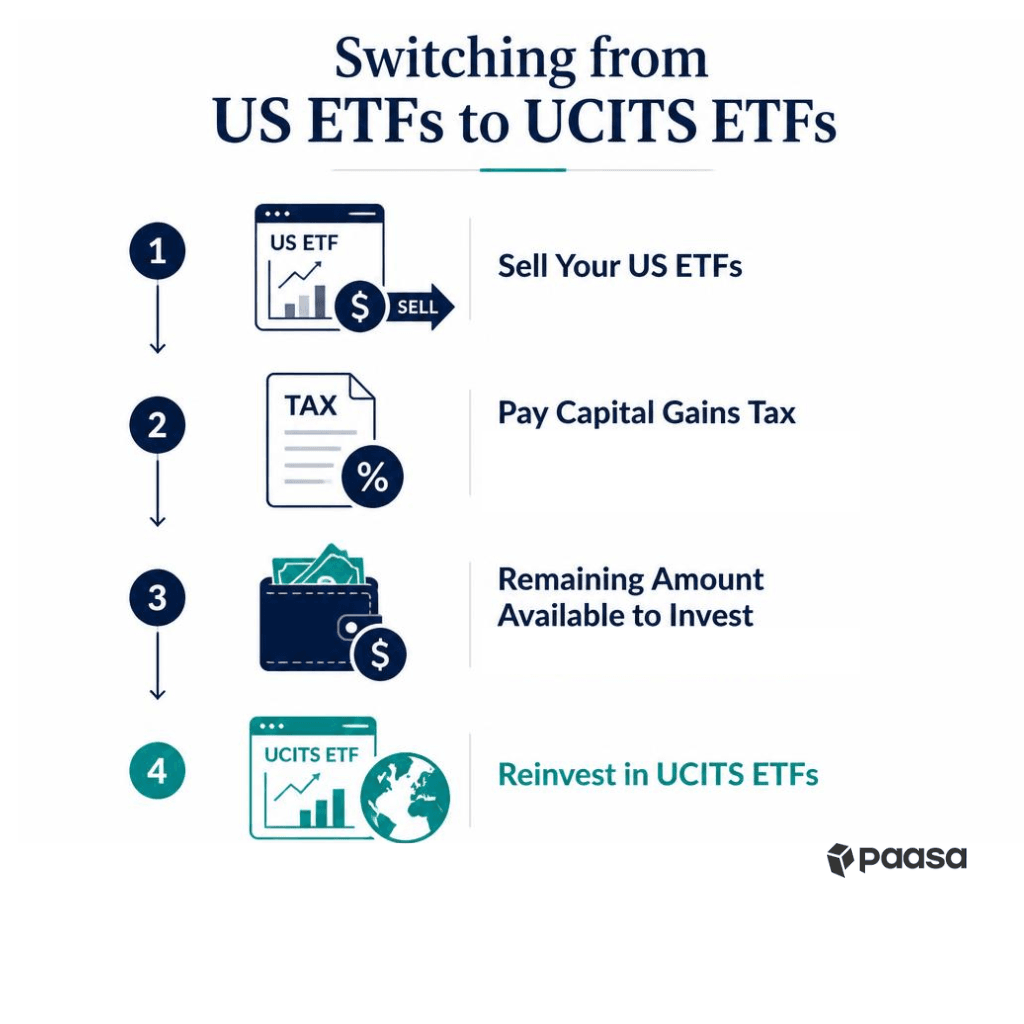
Tax liability on selling US ETFs
| Item | Value |
|---|---|
| Initial amount (A) | $2,000,000 |
| Cost basis (B) | $500,000 |
| Unrealized gain (A - B) (C) | $1,500,000 |
| LTCG tax rate | 12.5% |
| LTCG tax paid (12.5% of C) (D) | $187,500 |
| Surcharge at 15% (15% of D) (E) | $28,125 |
| Health and education cess at 4% (4% of D+E) (F) | $8,625 |
| Total tax (D+E+F) | $224,250 |
Note: Surcharge on long-term capital gains is capped at 15%. The higher 25% and 37% surcharge rates that apply to other income are not levied on capital gains, so 15% is the maximum regardless of how large the gain is.
Amount available for reinvestment = Initial portfolio value − Total tax paid
= US$2,000,000 − US$224,250 = US$1,775,750
The net proceeds of US$1,775,750 are reinvested into UCITS ETFs.
| Item | Value |
|---|---|
| Initial amount invested in UCITS ETFs (A) | $1,775,750 |
| Growth rate (YoY) | 10% |
| Number of years | 20 |
| Amount after 20 years (1.1^20 = 6.7275) (6.7275 * A) (B) | $11,946,358 |
| Tax owed at end (UCITS, no estate tax) | $0 |
| Amount heir finally gets (B) | $11,946,358 |
Although switching to UCITS ETFs requires paying US$224,250 in taxes upfront, your heirs ultimately receive US$11.95 million after 20 years, equivalent to an effective CAGR of ~9.3%.
Hence by avoiding US estate tax, your beneficiaries inherit approximately $11.95 million, compared with $8.14 million if the original US ETF portfolio is retained.
When does switching make sense?
Returning to India creates an opportunity to reassess how your international investments are structured. While there is no one-size-fits-all answer, switching from US-domiciled investments to UCITS ETFs may make sense for many investors once the PFIC rules are no longer a consideration.
Continuing to hold US stocks and US ETFs makes sense if you:
- Hold significant US-listed stocks or RSUs and want to continue owning those specific companies directly.
- Want access to segments of the US market or specific securities that are not easily replicated through UCITS ETFs.
Switching to UCITS ETFs makes sense if:
- Your US-situs assets exceed the US$60,000 estate tax threshold, making US estate tax a meaningful consideration for your beneficiaries.
For a large proportion of investors returning to India, particularly those with significant long-term portfolios, switching to UCITS ETFs provides a more tax-efficient estate planning outcome.
About Paasa
Paasa is an Indian investor's gateway to global investing, trusted by HNIs, family offices, and institutions to diversify into markets across the US, Europe, China, Japan, and beyond.
What sets Paasa apart is its India-facing compliance layer:
- FEMA and LRS compliance embedded into every transaction.
- Tax reporting and analytics built for Indian investors (LTCG, STCG, dividend tax, TCS tracking).
- End-to-end support for remittance structuring, reconciliation, and compliance queries.
Whether it's equities, ETFs, UCITS funds, managed strategies, or even helping you protect your RSUs from estate tax, Paasa provides a single transparent platform for global portfolios with the confidence that India-specific compliance is taken care of.

