


Five weeks of earnings across hyperscalers, chipmakers and enterprise software vendors have converted the AI capital spending debate from a question of magnitude into a question of timing.
The four largest hyperscalers alone are now guiding toward more than $700 billion in combined 2026 capital expenditure, up sharply from roughly $410 billion the year before, and every one of them has revised that guidance upward at least once during the year rather than down.
Nvidia, whose August 26 report will close the season, has itself guided to revenue near $91 billion for the quarter, a figure that would nearly double its year ago result.
The pattern that emerges once all thirteen names are placed side by side is not uniform. Chip and infrastructure suppliers are converting spending into revenue growth almost immediately, enterprise software vendors are booking early but real AI linked bookings, and the hyperscalers funding the buildout are the ones absorbing the near term margin and cash flow pain.
Table of contents
- The Hyperscaler Capex Escalation
- Where the Money Actually Lands
- The Software Layer's Turn to Monetize
- Limitation
The hyperscaler capex escalation
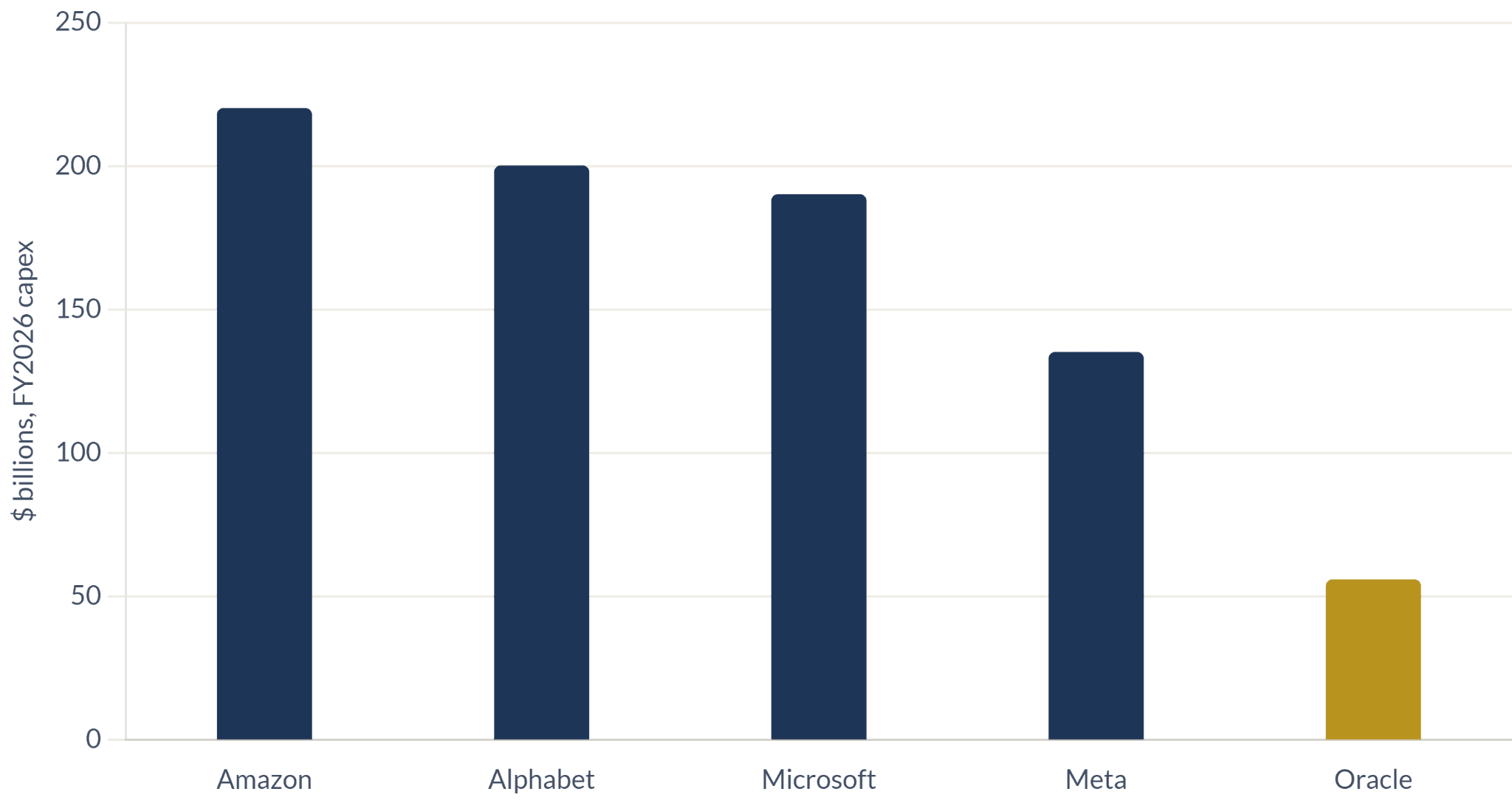
Amazon now expects to spend approximately $220 billion in cash capital expenditure in 2026, having lifted that figure from an earlier estimate near $200 billion on higher memory component costs, while still telling investors it will not have enough capacity to meet 2026 demand, let alone 2027 or 2028.
Alphabet raised its own full year range to $195 to $205 billion from $180 to $190 billion after a single quarter in which capital expenditure more than doubled year over year to $44.9 billion, a level that pushed free cash flow negative for the first time in the company's history.
Microsoft has held its calendar 2026 outlook near $190 billion even as quarterly spend crossed $50 billion, while Meta lifted its range to $125 to $145 billion.
Oracle, smaller in absolute terms but the most aggressive on a growth basis, spent $55.7 billion in the fiscal year just closed and has guided to a net cash capital outlay near $70 billion for fiscal 2027, a roughly 26% step up funded partly through additional debt and equity issuance rather than free cash flow, which was negative $23.7 billion for the year.
Where the money actually lands
The suppliers absorbing the hyperscaler spending are, so far, showing that the money converts into revenue quickly, if not yet into durable operating leverage.
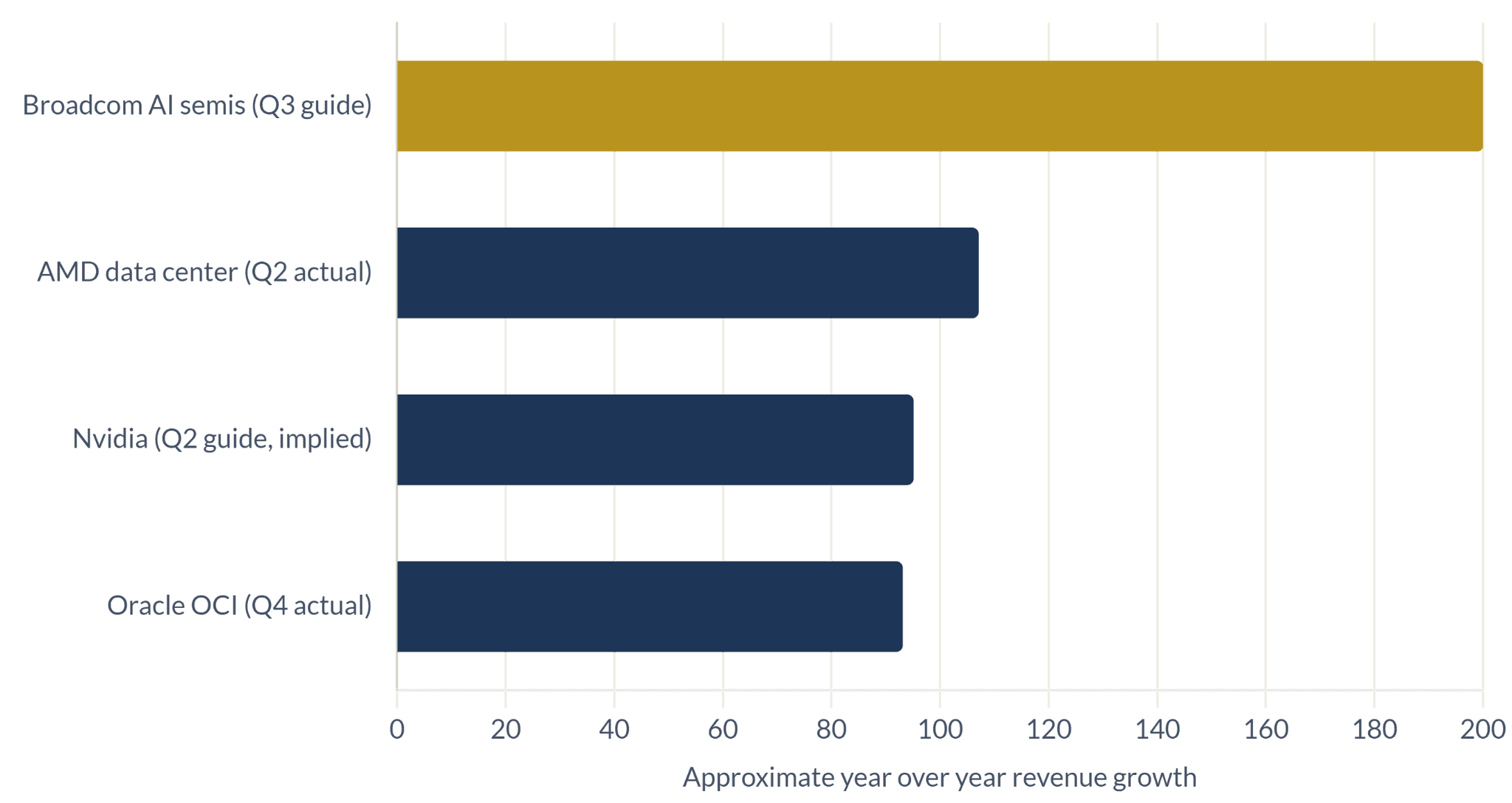
Broadcom guided third quarter AI semiconductor revenue to $16.0 billion, up more than 200% year over year, and reaffirmed a full year AI semiconductor target of $56 billion while pointing to more than $100 billion for fiscal 2027, though it also flagged that the AI heavy product mix will pressure consolidated gross margin toward roughly 74% even as operating margin holds near 67%.
AMD's data center segment revenue more than doubled to $6.7 billion in its most recent quarter, up 107% year over year, and management now expects that segment to more than double again in 2027 with server CPU growth above 70%.
Oracle Cloud Infrastructure revenue grew 93% in the fiscal fourth quarter. Nvidia's own guidance, not yet confirmed by results as of publication, implies growth of roughly 95% against last year's comparable quarter.
None of these four names has yet reported a margin contraction severe enough to alarm investors, which is precisely why the capex debate has shifted from the chip layer down to the hyperscalers writing the checks.
The software layer's turn to monetize
One layer removed from the infrastructure buildout, enterprise software vendors are reporting the first quarters in which AI linked bookings look like a genuine new revenue category rather than a marketing line item.
Salesforce's Agentforce annualized recurring revenue reached $1.2 billion, up 205% year over year, with combined Agentforce and Data 360 annualized recurring revenue at $3.4 billion.
ServiceNow's artificial intelligence annual contract value crossed $1 billion ahead of the company's own schedule, with agentic deployments up ninefold in nine months, while current remaining performance obligations rose 21% to $13.2 billion.
Palo Alto Networks guided next generation security annualized recurring revenue to $8.90 to $8.95 billion for its fiscal fourth quarter, up 59% to 60% year over year, as customers buy platform coverage explicitly to secure AI deployments.
Snowflake, which carries little of its own infrastructure capex because it runs on top of the hyperscaler clouds it is helping monetize, added 616 net new customers in its most recent quarter, up 38% year over year, and posted the best single day stock move in its history after the print.
Palantir's revenue grew 93% year over year with United States commercial revenue up 149%, prompting management to raise full year revenue guidance to 82% growth and US commercial guidance to 134% growth.
Limitations
Nvidia's Q2 fiscal 2027 results had not been reported as of publication, scheduled for August 26, 2026; all Nvidia figures cited reflect company issued guidance or analyst consensus, not actual results.
Capex figures are presented at the disclosed range midpoint for chart comparability where a range was given; actual full year spending may land anywhere within the range and several companies in this cohort have revised guidance more than once within a single fiscal year.
Stock reaction figures reflect the immediate post earnings trading session where available and do not capture subsequent price movement, which in several cases, notably Palantir and Alphabet, differed meaningfully from the initial reaction within days.
Broadcom's own earnings day stock reaction was not independently verified for this piece and is noted as such in the comparison table.

