

If you are an Indian tax resident with foreign assets or foreign-source income, you need to file an Income Tax Return (ITR) form that supports reporting these holdings and disclosures.
In most cases, this means using ITR-2 or ITR-3, depending on the nature of your income.
Choosing the correct ITR form is essential to accurately report foreign assets, foreign income, capital gains, and other mandatory disclosures required under Indian tax laws.
This guide explains when to use ITR-2 or ITR-3, and how to report details like Schedule FA, Schedule FSI, Schedule TR, and Form 67 correctly.
Which ITR Form Should You File?
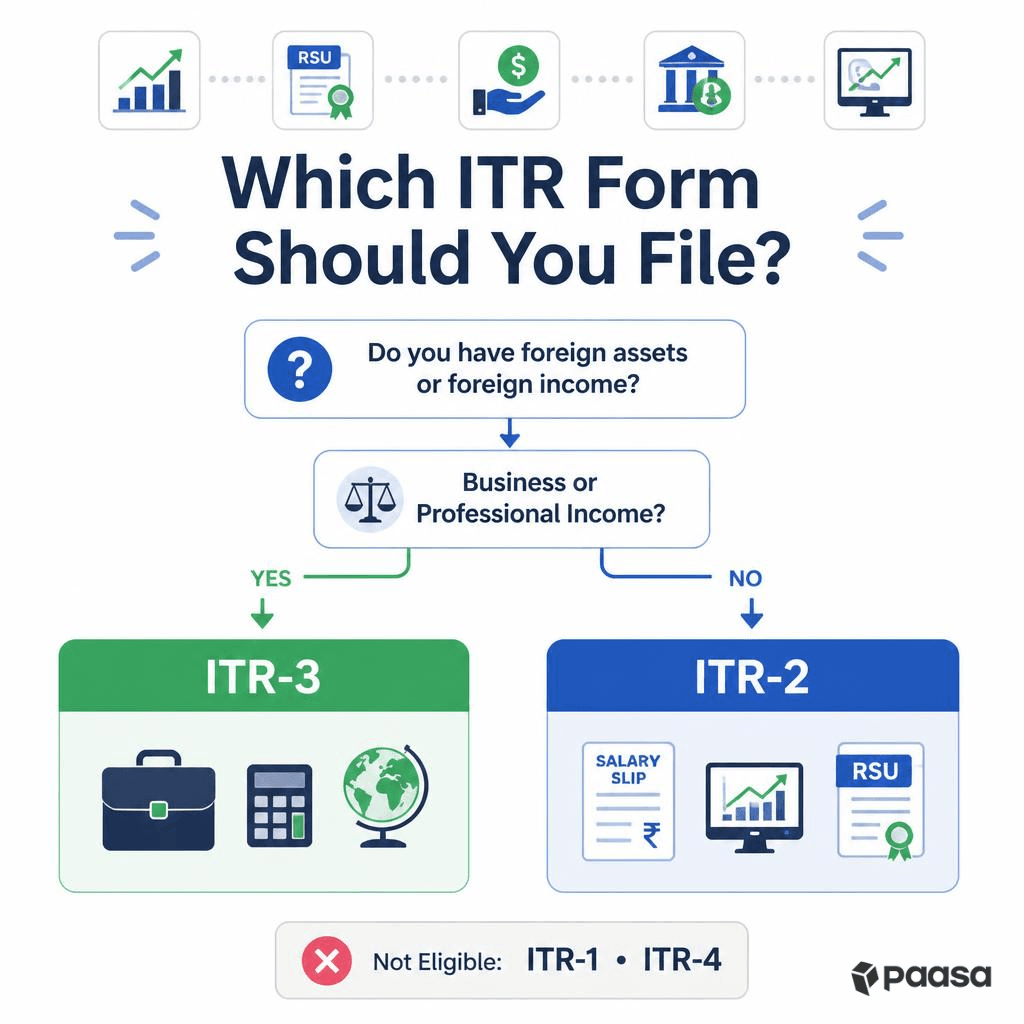
The ITR form you need to file depends on the type of income you earn and whether you own foreign assets or earn foreign-source income.
If you are a salaried employee with foreign assets, such as overseas stocks, RSUs, foreign dividends, or foreign bank or brokerage accounts, you will need to file ITR-2.
If you have business or professional income, including income from freelancing or consultancy, you should file ITR-3, even if you also hold foreign assets.
On the other hand, ITR-1 and ITR-4 are not applicable to resident taxpayers who own foreign assets or earn foreign-source income.
The table below provides a quick comparison of the four ITR forms.
| ITR Form | Who is it for? | Can you file if you have foreign assets or income? |
|---|---|---|
| ITR-1 (Sahaj) | Resident individuals with salary, one house property, and other income (subject to prescribed conditions) | No |
| ITR-2 | Individuals and HUFs with salary, capital gains, foreign assets, or foreign income, but no business or professional income | Yes |
| ITR-3 | Individuals and HUFs with business or professional income, including those who also have foreign assets or income | Yes |
| ITR-4 (Sugam) | Eligible taxpayers opting for the presumptive taxation scheme under Sections 44AD, 44ADA, or 44AE | No, if you have foreign assets or foreign income |
Common Filing Scenarios
The table below shows which ITR form is applicable for some of the most common situations involving foreign assets and income.
| Scenario | Applicable ITR Form |
|---|---|
| Salary income only | ITR-1 (if otherwise eligible) |
| Salary + RSUs from a foreign employer | ITR-2 |
| Salary + foreign shares or ETFs | ITR-2 |
| Salary + foreign bank account | ITR-2 |
| Salary + foreign brokerage account | ITR-2 |
| Salary + foreign dividends | ITR-2 |
| Salary + capital gains from foreign shares | ITR-2 |
| Business or professional income + foreign assets | ITR-3 |
| Presumptive business income + foreign assets | ITR-3 (not ITR-4) |
While these are some of the most common scenarios, your filing obligations also depend on the nature of your income and your residential status under the Income-tax Act. If you are required to file ITR-2 or ITR-3, you may also need to report your foreign assets and income through additional schedules in your return.
Additional Reporting Requirements
Filing the correct ITR form is only part of the process. If you have foreign assets or income, you must complete additional schedules and, in some cases, file Form 67.
Schedule FA
Schedule FA (Foreign Assets) is used to report foreign holdings such as bank accounts, brokerage accounts, shares, and RSUs. It is a disclosure requirement and does not create additional tax liability.
Read our detailed guide on Schedule FA to understand who needs to file it, what assets must be reported, and how to calculate the required values correctly.
Schedule FSI
Schedule FSI (Foreign Source Income) is used to report foreign income like dividends, interest, and capital gains. It helps determine eligible foreign tax credit under DTAA.
Schedule TR
Schedule TR (Tax Relief) records the foreign tax credit claimed for taxes paid abroad under DTAA or Indian tax provisions.
Form 67
To claim foreign tax credit, you must file Form 67 before or on the ITR due date. It includes details of foreign income and taxes paid. Missing this can impact your credit claim.
Read our detailed Form 67 guide to understand who needs to file it, the filing timeline, and the information required.
Common ITR Filing Mistakes
Owning foreign assets or earning foreign income adds reporting requirements. Common mistakes include:
- Filing ITR-1 or ITR-4. These forms are not valid if you have foreign assets or income. Use ITR-2 or ITR-3 instead.
- Not Reporting Foreign Assets in Schedule FA. Reporting income but not the assets themselves can lead to incomplete filing and scrutiny.
- Missing Foreign Income Reporting. Foreign dividends, interest, rent, and capital gains must be reported, even if taxed abroad.
- Not Claiming Foreign Tax Credit Correctly. To claim DTAA relief, report income properly and file Form 67 where required.
- Assuming RSUs Don't Need Reporting. RSUs, foreign shares, dividends, and gains all have reporting obligations beyond vesting tax.
Using the correct ITR form and completing all schedules ensures compliance.
How Paasa helps
Paasa is the platform used by global Indian investors, NRIs, and family offices to invest across US, UK, China, Singapore, Switzerland, and beyond.
Paasa's tax advisory service provides complete filing support, from calculating correct values and exchange rates to ensuring every schedule reconciles.
What documents does Paasa provide for tax filing?
At the end of the financial year, Paasa provides a ready-to-file tax package containing:
- Capital Gains Report: A clear breakdown of Short-Term vs. Long-Term capital gains, calculated using the 24-month holding rule for unlisted shares.
- Dividend and Interest Reports: Consolidated statements showing income earned and tax withheld abroad, making it straightforward to fill Schedule FSI.
- Schedule FA Report: Peak value and closing value of your entire portfolio in INR, calculated using the mandatory SBI TT Buying Rates. You can copy-paste these numbers directly into your ITR.
If you invest in global equities and have questions around taxation, FEMA, LRS, or compliance, feel free to reach out to our team.

